
The first week of cool nights in late September marks the start of a predictable seasonal ritual across Missouri: thousands of insects covering the south- and west-facing walls of homes, squeezing in around window frames, and accumulating in attics and wall voids to wait out the winter. The three species that dominate this migration in the Kansas City metro are the brown marmorated stink bug, the Asian lady beetle, and the boxelder bug. They are not structural pests, they do not reproduce indoors, and they do not feed on anything in the house. What they do, at volume and for weeks on end, is drive homeowners to call Kansas City pest control providers like ZipZap Termite & Pest Control in Lawson, usually after two or three failed rounds of DIY treatment that made the problem worse rather than better.
Why These Three Insects Show Up at Once
All three species are obligate overwinterers. Their biology requires a sheltered, dry, cold-tolerant location to survive the winter as adults. In their native ranges (eastern Asia for the stink bug and lady beetle, native North America for the boxelder bug), that meant cliff faces, rock outcroppings, and bark crevices. In a Midwestern residential landscape, sun-warmed residential siding reads to them as ideal habitat.
The triggers are environmental. Shortening day length tells the insects to start looking for shelter. Warm afternoon sun on south- and west-facing walls acts as a beacon. Most homes in Kansas City, Lee’s Summit, Liberty, and the Northland show peak activity between late September and mid-November, with lingering indoor emergence through late winter as pockets of the population warm up during heating cycles.
Identifying the Three Species Correctly
The treatment is the same regardless of which species is involved, but correct identification helps homeowners understand what they’re seeing and what to expect.
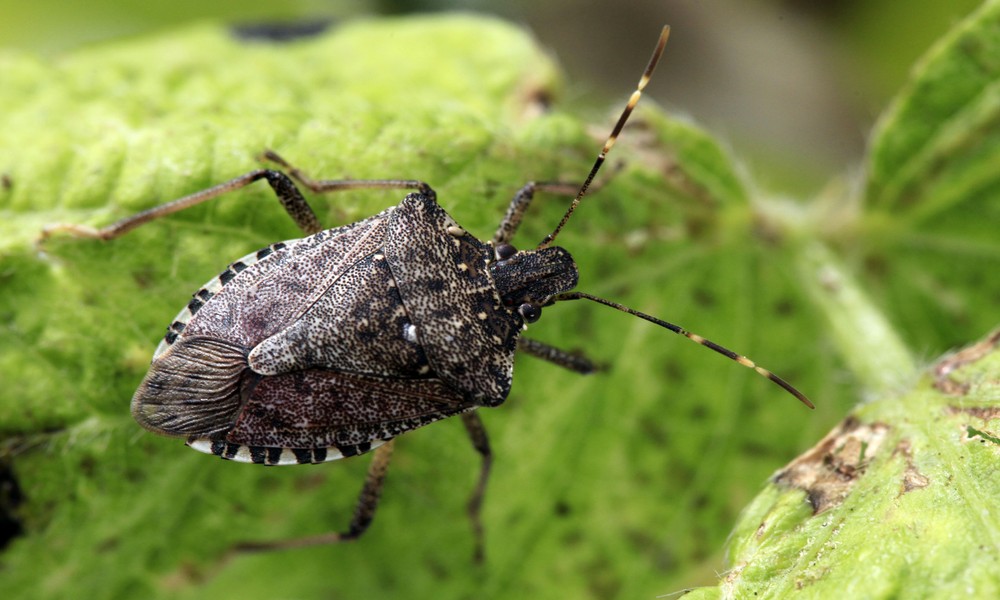
The brown marmorated stink bug (Halyomorpha halys) is a shield-shaped insect about 5/8 inch long, mottled brown with alternating light and dark bands on the antennae and the edge of the abdomen. It is invasive, first detected in the United States in Pennsylvania in the late 1990s, and now firmly established across Missouri. Its defensive odor, released when crushed or threatened, is distinct and persistent.
The Asian lady beetle (Harmonia axyridis) is often mistaken for the native ladybug. It is larger, typically 1/4 to 3/8 inch, with color ranging from yellow-orange to deep red, and usually bears an “M” or “W” shaped black marking on the white area behind the head. It also releases a defensive fluid (reflex bleeding) that can stain light-colored surfaces and carries a noticeable odor.
The boxelder bug (Boisea trivittata) is black with distinctive red or orange edging on the wings and a red line pattern on the thorax. It grows to about 1/2 inch and, unlike the other two, is native to North America. Populations are tied to boxelder, maple, and ash trees, and homes with mature specimens nearby tend to see the highest numbers.
Why Interior Spraying Makes the Problem Worse
The most common homeowner mistake is buying aerosol insecticide and spraying visible insects as they appear inside. That approach produces three predictable outcomes.
The dead insects accumulate inside wall voids and attic cavities, which over the winter attracts carpet beetles and dermestid beetles that feed on the carcasses and can become their own indoor pest problem.
Spraying kills the insects that have already completed their migration indoors, but it does nothing to stop the next wave, which will continue for weeks.
Residual sprays applied indoors on surfaces these species do not actually walk across (they spend most of their time in voids) provide minimal control relative to the label’s implication.
The correct intervention zone is the exterior, before the insects cross the threshold.
What Actually Reduces Fall Invader Pressure
Exterior perimeter treatment applied in late August or early September, before the first cool front, is the single most effective professional intervention. A residual pyrethroid applied to the south and west sides of the structure, around window and door frames, soffits, eaves, and foundation penetrations, creates a barrier that intercepts insects during their search for shelter. Timing matters. Treatment applied in October, after thousands of insects are already clustered on the siding, is significantly less effective than the same product applied three weeks earlier.
Structural exclusion carries most of the long-term load. Gaps around dryer vents, attic vents without proper screening, damaged soffit corners, separations around window frames, and utility penetrations through siding all serve as entry points. Sealing these with appropriate materials (backer rod and polyurethane sealant for wider gaps, fine mesh for vents) reduces indoor emergence dramatically.
Vacuuming is the correct response for insects already inside, not spraying. A shop vacuum with a bag that can be sealed and discarded handles interior populations without the residue and staining issues of wet treatments. For Asian lady beetles in particular, vacuuming prevents the reflex-bleeding staining that spraying sometimes triggers.
When Kansas City Pest Control Makes Sense
The calculation is usually about scale and recurrence. A handful of insects in the windows of one room is a seal-the-gaps problem. Hundreds on the siding each fall, weekly indoor emergence through winter, and visible clustering in attic spaces is a perimeter-treatment-plus-exclusion problem, and one that continues every year without intervention.
Companies with a board-certified entomologist on staff, including ZipZap Termite & Pest Control, tend to approach fall invaders as a structural inspection first and a spray application second. The inspection identifies where the insects are actually entering, which often reveals maintenance issues (failing caulk, damaged vent screens, gaps at rooflines) that matter for other pest categories as well.
The Short Version
Brown marmorated stink bugs, Asian lady beetles, and boxelder bugs are a seasonal Kansas City problem rather than a structural one, and treating them as an indoor issue is what keeps the problem alive year after year. The fix is exterior and preventive. A late August or early September perimeter treatment combined with exclusion work, handled by a Kansas City pest control provider such as ZipZap Termite & Pest Control, usually cuts fall emergence by a large margin in the first season and continues to improve with annual maintenance. Waiting until the insects are already on the wall in October generally means another winter of the same cycle.