
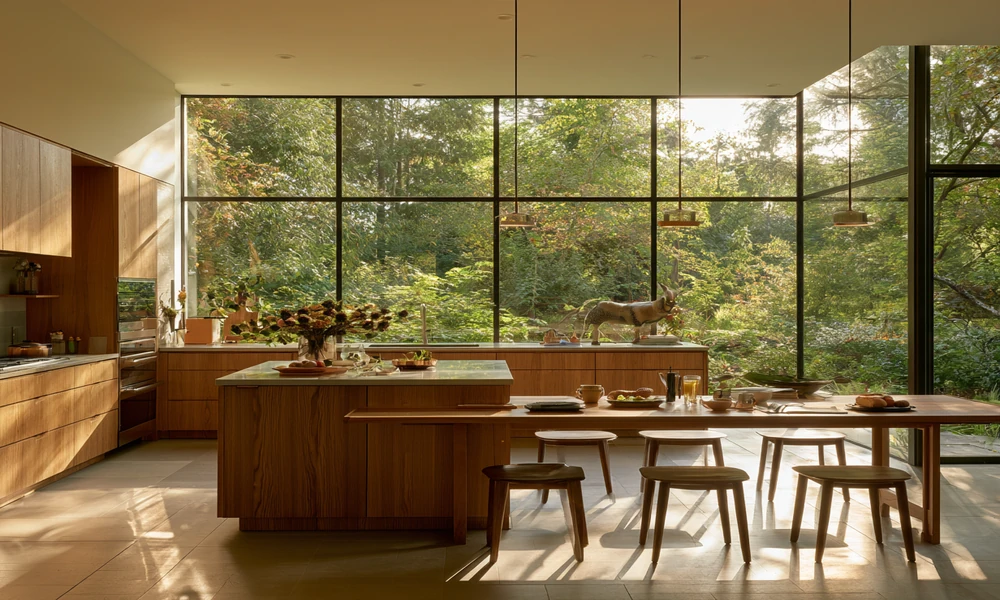
Mid century design has a strange kind of staying power. It came into its own decades ago, yet its clean lines, warm woods, and simple shapes still look right at home today. The problem starts when a kitchen copies the era too closely. Suddenly, the room can feel less like a stylish home and more like a movie set from 1962.
The best mid century modern kitchens avoid that problem. They borrow the warmth and character of the style without trying to recreate every detail from the past.
That is really the secret: take inspiration from the period instead of treating it like a rulebook.
Here is how to get the balance right.
Start With the Mid Century Feeling, Not the Theme
A common design mistake is trying to collect as many mid century features as possible.
Walnut cabinets? Check.
Orange backsplash? Check.
Globe lights? Check.
Terrazzo floor? Check.
Retro appliances? Check.
Put all of those things together, and the kitchen may start feeling like a time capsule.
Instead, think about what made the original style appealing. Mid century design valued function, simplicity, natural materials, and comfortable living. Rooms often felt open and uncluttered.
Those ideas are still useful today.
A modern kitchen can capture that feeling with flat-panel cabinets, natural wood, clean hardware, and a simple layout. You do not need every recognizable retro detail.
Let Wood Become the Star
Wood is one of the easiest ways to bring warmth into mid century modern kitchens.
Walnut is especially popular because of its rich brown color and visible grain. Teak-inspired tones and medium oak can work beautifully too.
The key is restraint.
Using wood cabinets from floor to ceiling can make a small kitchen feel heavy. One solution is to combine wood lower cabinets with lighter upper cabinets. Another is to use wood on an island while keeping the surrounding cabinetry simple.
You can also choose cabinets with a natural-looking grain rather than a glossy finish.
This gives the kitchen character without making it look old-fashioned.
Modern countertops help complete the balance. Light quartz, subtle stone, or another quiet surface can make warm wood cabinets feel much more current.
Flat-Panel Cabinets Do Most of the Work
If there is one cabinet style closely linked with mid century design, it is the flat-panel door.
There are no raised centers, decorative edges, or heavy moldings. The surface stays smooth and simple.
That makes flat-panel cabinetry useful for a modern interpretation of the style. It gives you the clean geometry associated with the period without screaming “retro.”
Hardware matters too.
Slim pulls, small knobs, or integrated handles can all work. Brass can add warmth, while matte black hardware creates stronger contrast. Stainless or brushed metal can give the room a cleaner contemporary edge.
Choose one direction and keep it consistent.
Too many different finishes can quickly weaken the simple character that makes this style attractive.
Skip the Obvious Retro Color Palette
Mustard yellow, avocado green, burnt orange, and brown all have strong links to mid century interiors.
That does not mean you need to use them together.
Modern versions of these colors tend to work better when they are softer, deeper, or used in smaller amounts.
Try olive instead of bright avocado. Consider ochre rather than loud yellow. A muted clay shade can replace intense orange.
Better yet, build most of the kitchen around neutrals and introduce one period-inspired color.
For example, walnut cabinets could sit beside warm white walls and an olive island. A neutral kitchen might get personality from rust-colored stools.
Color should feel intentional rather than nostalgic.
Mix Old Ideas With New Materials
This is where mid century modern kitchens can become truly interesting.
Do not limit yourself to materials that would have appeared in a 1950s home. Combining mid century forms with modern surfaces keeps the room connected to the present.
Imagine walnut flat-panel cabinets paired with a thin quartz countertop. Add a simple stone backsplash and modern induction cooktop. The cabinets reference the past, while everything around them feels current.
You could also combine wood cabinetry with concrete-look surfaces, porcelain tile, contemporary glass, or subtle veined stone.
The contrast prevents the room from becoming too literal.
A kitchen does not have to be historically accurate to be beautifully designed.
Be Careful With Statement Lighting
Lighting is one of the fastest ways to push this style too far.
Sputnik fixtures, colorful pendants, and large globe lights are strongly connected to mid century design. They can look fantastic, but several dramatic fixtures in one room may make the theme feel forced.
Pick one moment.
A pair of simple globe pendants above an island might be enough. Everywhere else, use quiet recessed lighting or understated fixtures.
This creates a focal point instead of filling the kitchen with competing references.
Scale is equally important.
A huge vintage-style chandelier can overpower a small kitchen. A more restrained fixture often creates the same mid century hint while keeping the room airy.
Keep the Backsplash Quiet-or Make It the One Big Moment
Backsplashes offer two good directions.
The first is to stay simple. Warm white tile, understated stone, or a slab backsplash lets wood cabinets and furniture receive more attention.
The second is to turn the backsplash into the kitchen’s main retro reference.
Geometric tile can work particularly well here. Look for simple patterns rather than extremely busy prints. Muted colors also make geometric designs easier to live with.
The important part is choosing.
If the backsplash is bold, countertops, cabinets, and lighting should usually become quieter.
Good mid century modern kitchens have personality, but they also know when to stop.
Bring in Furniture-Like Details
Original mid century homes often blurred the line between furniture and built-in design. That idea can make a modern kitchen feel warmer.
An island with visible legs, for example, can look more like a piece of furniture than a solid cabinet box.
Open shelving can create a similar effect when used carefully. A few wooden shelves displaying ceramics, glasses, or cookbooks can soften a wall of cabinetry.
Even counter stools can do some of the design work.
Look for simple silhouettes, tapered legs, curved backs, and natural materials. You do not need exact reproductions of famous vintage furniture.
The shape is often enough to suggest the style.
Do Not Hide Modern Technology
Trying to make every appliance look vintage can actually make a kitchen feel more dated.
Modern appliances belong in modern homes.
A sleek refrigerator, induction range, built-in oven, and contemporary faucet can sit comfortably beside mid century-inspired cabinetry. Their clean forms often work naturally with the style.
You can integrate large appliances behind cabinet panels if you want a calmer look, but it is not required.
Function was important to mid century designers. Using today’s best kitchen technology is completely consistent with that idea.
Leave Some Empty Space
One of the most overlooked secrets is also one of the simplest: do less.
You do not need decor on every wall.
You do not need open shelves everywhere.
You do not need five different wood tones.
And you certainly do not need every famous mid century motif in the same room.
Visual breathing room allows the strongest elements to stand out.
If beautiful walnut cabinets are already providing warmth and texture, let them speak for themselves. If the backsplash has a bold geometric pattern, keep nearby surfaces calm.
Restraint makes a kitchen feel designed rather than decorated.
Use Nature to Soften the Straight Lines
Mid century architecture often emphasized a connection between indoor and outdoor spaces. Bringing a little nature into the kitchen is an easy way to continue that idea.
Large windows are ideal when the architecture allows them. Natural light makes wood cabinetry look especially rich.
Plants provide another simple option.
A tall plant near a window or a few herbs on the counter can soften the straight lines of flat-panel cabinets.
Natural textures can help too. Wood stools, woven details, ceramic pieces, and stone surfaces keep the kitchen from feeling overly polished.
The goal is warmth, not perfection.
Think “Modern Kitchen With Mid Century Character”
This simple mindset can prevent many design mistakes.
Instead of asking, “How do I make my kitchen look mid century?” ask, “How can I give my modern kitchen some mid century character?”
The difference may sound small, but it changes your choices.
You stop trying to match an era. You start selecting the parts of the style that still make sense for the way people live today.
Maybe that means walnut cabinets and globe pendants.
Maybe it means flat-panel doors, an olive island, and tapered stools.
Or perhaps it is simply warm wood, uncluttered surfaces, and strong horizontal lines.
There is no need to check every box.
The Secret Is Knowing What to Leave Out
The most successful mid century modern kitchens are not copies of kitchens from the past. They are contemporary spaces that understand why mid century design became loved in the first place.
Keep the clean lines. Use warm natural materials. Choose simple shapes. Add one or two playful references to the era.
Then stop.
Pair those choices with modern countertops, efficient appliances, practical storage, and today’s lighting. Give each feature enough room to breathe.
That balance creates a kitchen that feels familiar without feeling frozen in time.
And that may be the best part of mid century modern design: you can enjoy its warmth, simplicity, and personality without making your kitchen look like it has been waiting for you since 1960.